Translate

Sunday, April 27, 2014

Proud of my student's work!

Nancy Greenland is one of my special students.  She too is fearless.  Her imagination starts spinning new webs from the moment she awakens in the morning.Here are some photos of her work from the last workshop at the Pioneer Florida Museum.  She has turned them into mxed media pieces and created things with her prints that can be used in everyday circumstances.  I hope you enjoy them as much as I do.


A lovely eco print on felt with tree trunks added with a 
Sharpie pen after the print dried.

Another eco print on felt, that was wrapped around a tin can during cooking.  
After drying the print was mounted on a scrap of wool felt then a canvas frame was wrapped with black wool felt and the eco printed piece was stitched to it.  Nancy thought the finishing nails looked like an old fence, so she stitched a flock oof birds landing on the posts.  The tree is 3-d.  It is made from a group of the wires from a steel belted radial tire.  This tree was used to print on the next photo piece, then appliqued to this printed background.  Red running stitches in two rows accent the piece and repeat the color of the bird.


Another piece of eco printed felt, wrapped around a tin can with an impression from the tree in the photo above.Like in the photo above, the piece was mounted to a scrap of wool felt then appliqued to a larger piece of felt wrapped around a canvas frame.  Both of these pieces were gifts to me at he last workshop.


This lovely  print of Turkey Oak leaves and Lquidambar leaves with a small scrap of chicken wire on beige card stock was mounted on a black blank card.  A piece of white unlined bond paper was appliqued to the interior for writing on. It has a black envelope and is really elegant.


This is just a lovely piece of eco printing on felt turned into a mixed-media piece with buttons applied to the surface, a tiny stitched bird.  The impression from the metal tree was not strong enough, so Nancy stitched a twisted trunk and branches.  Finishing nails and a couple of pieces of wire printed the fence once again.

This lovely card has an eco print mounted on black card stock, then mounted again on brown card stock.  The card was run through an inj-jet printer and the work "thanks" was printed on the print. Metal washers that had been distressed were glued on the front in a curvy pattern

This lovely print of Oak and other crumbled dried leaves was eco printed on beige card stock.  The print was put through  an inkjet printer where the crow photo was printed.  The print was then mounted on black card stock.  Is is absolutely lovely!


Saturday, April 26, 2014

New Books on the shelf!

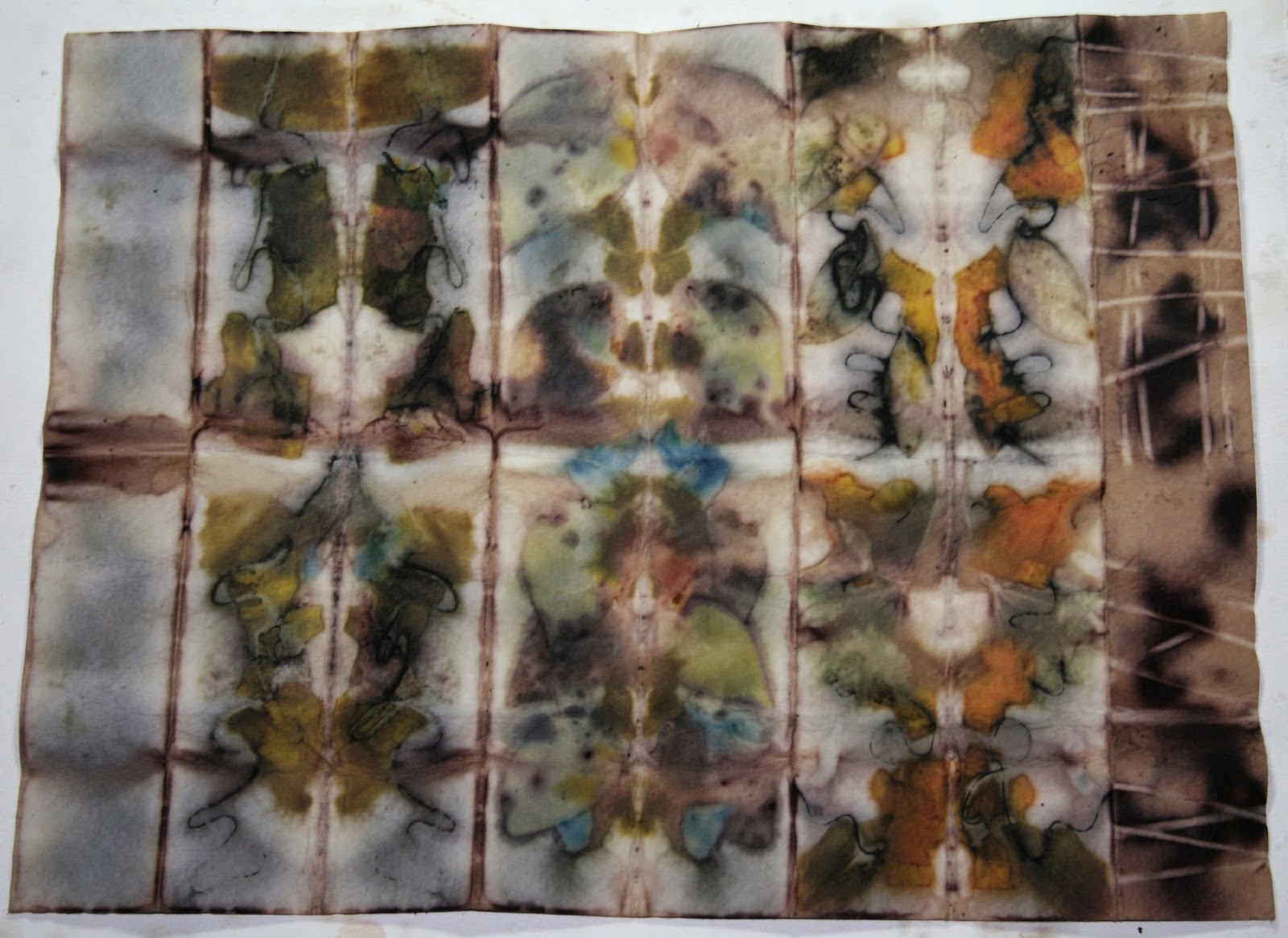
I just took two new books out of the cook pot yesterday and I'm still doing the happy dance.  I achieved some incredible color and prints.  I included vintage doilies along with plant materials for the first time and both printed on the water color paper.  The large one is 7.5 inches x 11 inches, on Rives BFK cold pressed, 140 lb., the other is 4.5"x6" on Strathmore 400 series watercolor 140lb. cold pressed.  Both cooked in the same dye pot and bath, but you couldn't tell it by the color achieved.  Red and blue flower petals are usually quite fugitive for me, but this time I was rewarded with small miracles. I have never ever gotten such a bright yellow, and no metals were used in the bath, some tiny steel wires were used on a couple of the prints, and some of the doilies had been previously printed using the steel wires, but nothing prepared me for such bright yellows.  I hope the photos can do them justice.  They really are lovely.

Friday, March 14, 2014

Thank You!

My blog went over 20,000 views this morning.  I couldn't believe how many people have seen my pages!   Thank you all for your visits and your comments.  We have come a long way.  When I returned from Europe two years ago next month, only 3000 people had viewed my blog in 3 years.  It shows the interest in our art and processes.  Again, thank you.

Crazy for Cranesbill!

Driving home from shopping, I noticed a large clump of wild cranesbill (Geranium dissectum) growing on the side of the road.  This is an invasive species where I live, so I didn't mind pulling it up to try printing with it.  I used a two fold-4 page card of 140# watercolor paper, and soaked the paper in water/vinegar mixture.  I decided to place the  Geranium leaves in a container of washing soda/water that I had left over from mordanting some papers.  I created a stack between two ceramic tiles and steamed the stack in the pressure cookeer on a rack above the water for 10 minutes.  The single page of leaves had no washing soda.  The double page print had washing soda and produced 3 colors.  Less color without the washing soda.

The second print was on a white cotton handkerchief with crocheted edging and soaked in vinegar/water..  I used cranesbill leaves without soaking the leaves, and added two fine steel wires.  Not as much color, but reaction of leaves to iron made nice edges and a hint of purple/black.


Dilly Dallying with Doilies!

I was inspired by the work of Giedra Dagiliene and Jeanne H. McLaughlin who have been experimenting with using doiles in their Eco Dyeing, I decided to try Eco Printing on 2 vintage cotton doilies myself.  I used the leaves of Liquidambar (Sweet Gum) and some rusted wire.  The two doilies were stacked and steamed between two 6" ceramic tiles in the pressure cooker on a rack above the water for 10 minutes.  After cooling, the vegetable mater and wire were removed and the prints allowed to dry.  Here are the printed doiles.

Saturday, March 8, 2014

New "produce" for canning, Books and Prints!

Going one step further from canning dye extracts and leaves or barks, I tried my and at making paThe rest are saved for my workshop on the 23rd of March.


Have you canned your prints lately!

India Flint has published a Blurb book called Stuffed Steeped & Stored.  In it she describes a way to color  and print fabrics, and papers using a minimum of fresh plant material.  If you are familiar with canning or preserving using the Hot Water Bath canning method or Pressure canning, you can do the same thing.  I grew up helping to can and preserve produce and jams and jellies with my family since I was about 10 years old.  My first canning experience with dyeing was back in July 2011 when I placed fabric and cosmos dye in a quart jar and sealed it to see if the dye would take.   It did.  In May of 2011, I canned 12 quarts of vegetable material to make my own dye extracts.  Those jars are still sealed today, except for one.  A jar of Eucalyptus bark became unsealed.  There is no sign of mold or mildew inside that jar 2 years later.  Could it be because Eucalyptus is both anti-fungal and Anti-bacterial?  Here are some photos of the canned dyestuffs:
2 bQts. of Elderberry extract from 2012

Left, Mullien extract, right, Eucalyptus bark extract, both from 2012
Lt. to rt.:  Elderberry extract, new Eucalyptus bark extract, cosmos extract and 2012 Eucalyptus extract
12 quarts of dyestuffs from 2012, still unopened and stronger in color.